

“I realized that the true fiction of a lawyer was to unite parties… A large part of my time during the 20 years of my practice as a lawyer was occupied in bringing out a private compromise of hundreds of cases. I lost nothing thereby- not even money, certainly not my soul.”
-Mahatma Gandhi
The concept of Alternative Dispute Resolution (ADR) has introduced a new mechanism of dispute resolution that is non-adversarial. The justice dispensation system in India has found an alternative to Adversarial litigation in the form of an ADR Mechanism.
Introduction of new methods of dispute resolution such as an alternative dispute resolution mechanism facilitate parties to deal with the underlying issues in dispute in a more cost-effective manner and with increased efficacy. Also, these processes have the advantage of providing parties with the opportunity to reduce hostility, regain a sense of control, gain acceptance of the outcome, peacefully resolve conflict, and achieve a greater sense of justice in each case. The dispute resolution usually takes place usually in private and is more feasible, economical, and more efficient. ADR can be classified into four types: negotiation, mediation, collaborative law, and arbitration. (Sometimes a fifth type, conciliation, is included as well, but for present purposes, it can be regarded as a form of mediation.)
An estimate of 31 million cases pending in various courts across India. The National Judicial Data Grid estimates that more than three crore cases pending across courts, with approximately 65 lakh cases pending for over five years. It has been estimated that 12 million Indians await trial in criminal cases throughout the country. On average, it takes twenty years for a real estate or land dispute to be resolved. A 2009 law commission report said it would take 464 years to clear pending cases.
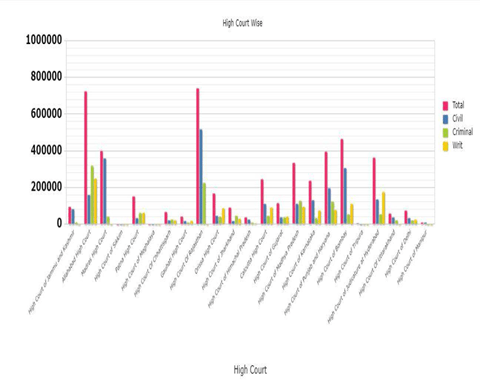
The above table shows that across 4 million cases are pending across high courts in India.
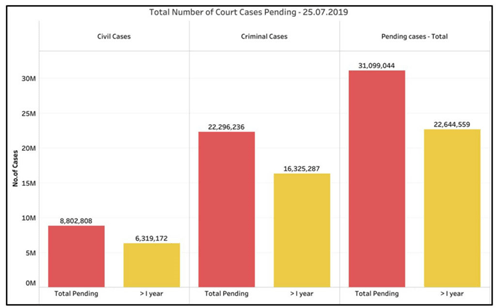
The above table shows that the lower judiciary is more burdened with over 2 million cases as of 25.07.2019.
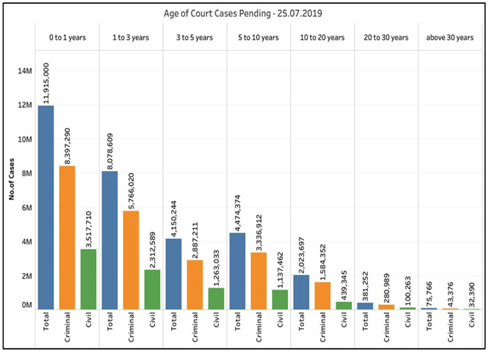
The above table shows the number of years since the cases are pending in the courts as of 25.07.2019.
The above statistics reiterate the need for reforms not only in speeding up dispute resolution but also have a strong in-country mechanism for out of court dispute resolution. The dispute resolution process has a huge impact on the Indian economy and the global perception of “doing business” in India. This is clearly indicated by the World Bank rating on Ease of Doing Business 2016 which has ranked India 131 out of 189 countries on how easy it is for private companies to follow regulations. Arbitration can be an alternative dispute resolution mechanism to enhance the ease of doing business. It can greatly reduce the pressure on courts, thereby reducing pendency, as well as instill investor confidence, if the dispute-resolution processes are efficient, swiftly expedited, and effective.
India is ranked 63 among 190 economies in the ease of doing business, according to the latest World Bank annual ratings. The rank of India improved to 63 in 2019 from 77 in 2018.[1] The Ease of doing business index ranks countries against each other based on how the regulatory environment is conducive to business operations. Economies with a high rank (1 to 20) have simpler and more friendly regulations for businesses.
The huge pendency of cases in courts is the primary reason among other reasons to have caused great stress to the system of dispensing justice in India. There has been a considerable rise in the number of cases being filed in the courts in recent years and this in turn has stressed the justice delivery system thus emphasizing the need for alternative dispute resolution methods. And, it is in this context that a Resolution was adopted by the Chief Ministers and the Chief Justices of States in a conference held in New Delhi on 4th December 1993 under the chairmanship of the then Prime Minister and presided over by the Chief Justice of India.
The resolution so adopted stated that: “The Chief Ministers and Chief Justices believed that Courts were not in a position to bear the entire burden of the justice system and that several disputes lent themselves to resolution by alternative modes such as arbitration, mediation, and negotiation. They emphasized the desirability of disputants taking advantage of alternative dispute resolution which provided procedural flexibility, saved valuable time, money, and avoided the stress of a conventional trial”.
India, being a developing country, has taken major economic reforms underway within the framework of the rule of law, strategies for a quick dispensation of justice and to provide for expeditious resolution of disputes for reducing the judicial burden. Therefore, to reduce the burden of the courts there is no better option but to strive to develop alternative modes of dispute resolution (ADR) by establishing facilities for providing settlement of disputes through arbitration, conciliation, mediation, and negotiation.
The Alternative Dispute Resolution Mechanism would have a greater impact on reducing the judicial burden and it is more client-centric. It is an effort to design a workable and fair alternative to our traditional judicial system which is quick and easily affordable. There are various ADR techniques viz. arbitration, mediation, conciliation, mediation-arbitration, mini-trial, private judging, final offer arbitration, court-annexed ADR, and summary jury trial which can play a major role in reducing the stress of the justice delivery system.
The techniques of ADR have been developed on scientific lines in the USA, UK, France, Canada, China, Japan, South Africa, Australia, and Singapore and the same has emerged as a significant movement in these countries. It is not only helped reduce cost and time taken for resolution of disputes, but also in providing a congenial atmosphere and a less formal and less complicated forum for various types of disputes.
The Arbitration Act, 1940 was unable to meet the requirements of both the international and domestic standards of resolving disputes. The judicial delays along with the court intervention frustrated the very purpose of arbitration as a means for expeditious resolution of disputes. This is where the Hon’ble Supreme Court in several cases repeatedly pointed out the need to change the arbitration law to achieve the objective that was sought to be achieved through alternative modes. The Public Accounts Committee too deprecated the Arbitration Act of 1940.
The movement towards the ADR was endorsed by a resolution at a conference[2] of Chief Justices, Chief Ministers and Law Ministers of all the States. It was decided that since the entire burden of the justice system cannot be borne by the courts alone, an Alternative Dispute Resolution system should be adopted. Similarly, there were significant changes demanded by the trade and industry in the Arbitration and Conciliation Act, 1940. The Government of India thought it necessary to provide a new forum and procedure for resolving international and domestic disputes expeditiously.
Thus, “The Arbitration and Conciliation Act, 1996” came into being. The law relating to Arbitration and Conciliation was also almost the same as in the advanced countries. Conciliation has been given statutory recognition as a means for the settlement of the disputes in terms of this Act. In addition to this, the new Act also guarantees independence and impartiality of the arbitrators irrespective of their nationality. The newly enacted Arbitration and Conciliation Act of 1996 brought about several changes to expedite the process of arbitration. And thus, this system of ADR has developed confidence among foreign parties interested to invest in India or to go for joint ventures, foreign investment, transfer of technology, and foreign collaborations. And, thus, it is the spirit that kept justice alive. In the words of LJ Earl Warren, “It is the spirit and not the form of law that keeps the justice alive.”
[1] Ease of Doing Business in India. 2008-2019 at https://tradingeconomics.com/india/ease-of-doing-business
[2] Held on 04.12.1993
DECLARATION
I, Hitesh Vachhani, do hereby declare that this work is the result of my own intellect and the necessary references are provided in the article. This article is only for an academic purpose. The matter embodied has been properly referenced and acknowledged to avoid any kind of copyright issues.
 JURISTIC LEGAL
Thank you for such a perfect knowledge on ADR. This helped me alot for my ADR records.
LikeLike